

Quick Answer: Standard commercial property conditions in India in 2026 refer to a set of benchmarks covering RERA compliance, Grade-A infrastructure, green certification (IGBC/LEED), institutional-grade tenancy, sustainable rental yields of 7–12%, and AI-ready building infrastructure — a significantly elevated standard compared to 2020. The market stands at USD 53.53 billion in 2026 and is expected to reach USD 116.26 billion by 2031.
Before the full analysis, here are four standout developments that set the benchmark for standard commercial property conditions in 2026: M3M The Line (Sector 72, Noida) offers high-street retail in a high-density residential corridor; M3M Jewel Crest Avenue (Sector 97, Noida) — India's first Jacob & Co. branded luxury commercial destination — redefines luxury retail; GYGY Mentis (Sector 140, Noida) delivers RERA-approved office and retail spaces in a fast-growing belt; and Group 108 Grandthum (Techzone 4, Greater Noida West) is a 23-acre, IGBC Pre-Platinum certified, mixed-use landmark.
Standard commercial property conditions, as understood by institutional investors, RERA authorities, and Grade-A occupiers in June 2026, encompass the following minimum criteria:
This definition has evolved significantly over six years. Understanding that evolution is essential for any investor or occupier making decisions in today's market.
This is the core question this report answers. The short answer: the floor has risen dramatically. What was "premium" in 2020 is "standard" in 2026.
COVID-19 compressed demand, inflated vacancies, and froze construction timelines across India's commercial real estate sector. Standard commercial property conditions in 2020 were characterised by:
What the pandemic did accelerate, however, was awareness. Large occupiers began demanding features they had previously treated as nice-to-have: touchless access, better air filtration, flexible layouts, wellness-certified environments. These demands permanently redrew the baseline for what constitutes a genuinely investment-grade commercial property.
Recovery came — but selectively. The flight-to-quality pattern that defines standard commercial property conditions in 2026 began here. Grade-A spaces with proper HVAC, larger floor plates, and credible developers absorbed demand at the expense of legacy buildings. Occupiers returned to physical offices with a checklist they had never held before.
Retail during this period pivoted meaningfully. The pandemic had proved that high-street retail and neighbourhood commercial centres outperformed large destination malls in resilience. Developers who had positioned projects as mixed-use, experience-driven destinations — combining daily-need retail with dining, entertainment, and service anchors — found demand recovering faster. This is precisely the format that Group 108 Grandthum and M3M The Line represent.
By 2022, Grade-A office absorption had recovered significantly, driven by technology companies and the first wave of Global Capability Centre (GCC) expansion that would define the next three years.
The 2023–2024 period marked India's commercial real estate entering a genuine, data-confirmed expansion phase. Key drivers:
Projects meeting elevated conditions — green-certified buildings, PropTech integrations, quality anchors — commanded 10–20% premium rents over standard competing stock during this period.
Price benchmarks during 2023–2024:
| Segment | 2023 (₹/sq. ft.) | 2024 (₹/sq. ft.) | YoY Change |
|---|---|---|---|
| Grade-A Office, NCR | ₹7,500–₹12,000 | ₹8,500–₹14,000 | +10–15% |
| High-Street Retail, Noida Expressway | ₹18,000–₹28,000 | ₹22,000–₹35,000 | +15–20% |
| Premium Branded Retail | ₹28,000–₹45,000 | ₹32,000–₹55,000 | +12–18% |
India's commercial real estate market is valued at approximately USD 53.53 billion as of 2026, on a trajectory to reach USD 116.26 billion by 2031 — a 16.8% CAGR. This is not speculative: it reflects confirmed demand from GCCs, e-commerce logistics, data centres, and flex operators that are already signing leases.
Institutional investment in Q1 2026 alone reached USD 1.6 billion — a 26% year-on-year increase and the highest Q1 deployment since 2021. The office segment led with USD 1.0 billion (64% of total). Critically, domestic investors accounted for 76% of total institutional capital in Q1 2026 — surpassing foreign inflows for the third consecutive quarter — a structural signal, not a quarterly anomaly.
India hosted over 1,700 Global Capability Centres by December 2025, collectively absorbing nearly 60 million sq ft annually. Grade-A office demand is expected to reach 70 million sq ft in 2026, against projected new supply of 55–60 million sq ft — meaning the market is running below replacement demand.
Office vacancy across India's top eight cities averaged 13.85% in Q1 2026, declining approximately 191 basis points year-on-year. Rentals are expected to firm up 5–10% versus 2024 levels. In Bengaluru's Outer Ring Road corridor — India's most active commercial micro-market — rents reached ₹90–110 per sq ft per month in 2025, a 20% premium over suburban alternatives.
Flexible workspaces are projected to account for 20% of all Grade-A leasing in 2026, with total flex stock reaching 85–90 million sq ft nationally. GCCs are expected to contribute 40–45% of total enterprise flex demand. Any project positioning itself as meeting standard commercial property conditions must now accommodate or integrate flex operators. This is no longer optional.
High-street retail in prime corridors saw some of the most dramatic appreciation across the 2020–2026 cycle. Premium branded retail developments — particularly those co-developed with global brands or positioned as lifestyle destinations — are now commanding ₹32,000–₹60,000 per sq ft, delivering commercial rental yields of 8–12% for well-leased assets.
The convergence of shopping, dining, entertainment, and lifestyle under a single roof is no longer a differentiator — it is a standard commercial property condition for any retail investment expected to attract institutional tenants and consistent footfall.
The table below represents broad market pricing in Delhi-NCR and the Noida commercial corridor — the most active investment geography for the projects covered in this report.
| Year | Grade-A Office NCR (₹/sq. ft.) | Retail – Noida Expressway (₹/sq. ft.) | Commercial Rental Yield |
|---|---|---|---|
| 2020 | ₹5,500–₹8,000 | ₹12,000–₹18,000 | 5–6% |
| 2021 | ₹5,800–₹8,500 | ₹13,000–₹20,000 | 5–6.5% |
| 2022 | ₹6,500–₹10,000 | ₹15,000–₹22,000 | 6–7% |
| 2023 | ₹7,500–₹12,000 | ₹18,000–₹28,000 | 7–8% |
| 2024 | ₹8,500–₹14,000 | ₹22,000–₹35,000 | 7.5–9% |
| 2025 | ₹9,000–₹16,000 | ₹26,000–₹45,000 | 8–10% |
| 2026 (current) | ₹10,000–₹18,000+ | ₹30,000–₹60,000 | 8–12% |
M3M The Line in Sector 72, Noida represents the high-street retail format that has outperformed legacy malls across the 2020–2026 cycle. Located within a dense residential catchment, the project combines ground-level retail, F&B outlets, and entertainment in a walkable commercial spine.
M3M India, founded in 2010 under the leadership of Basant Bansal, Roop Bansal, and Pankaj Bansal, has delivered over 50 projects and 30 million sq ft of space. That delivery track record is itself a component of standard commercial property conditions — institutional tenants and investors now require verifiable developer history before committing. M3M's Sector 72 positioning — close to the Noida-Greater Noida corridor and well-connected residential sectors — gives The Line a structural demand advantage in footfall generation.
Key investment metrics: High-street retail format; prominent NCR developer; dense residential catchment driving consistent footfall; connectivity to major Noida arterial roads.
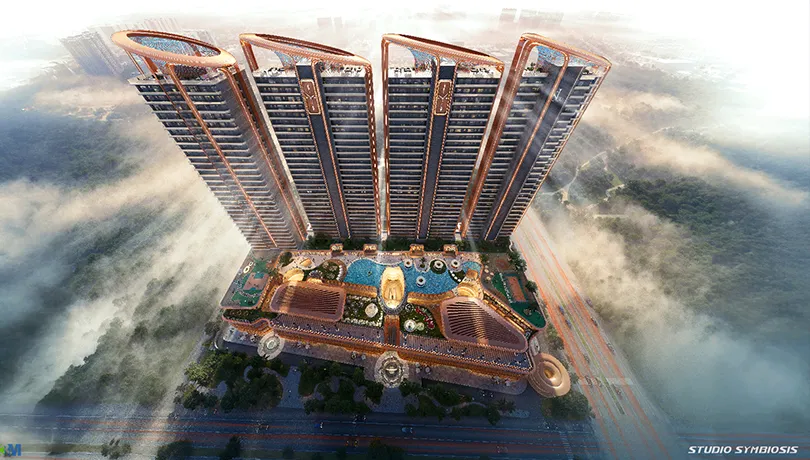
M3M Jewel Crest Avenue is among the most distinctive commercial launches in the NCR in recent years. Developed as part of the M3M Jacob & Co. mixed-use masterplan in Sector 97, Noida, this RERA-registered project (registration number UPRERAPRJ690055/10/2025, approved October 3, 2025) is spread across 5.8 acres along the Noida–Greater Noida Expressway.
The project offers retail shops ranging from 500 sq ft to 4,350 sq ft and premium showroom configurations. Pricing ranges from ₹32,000 per sq ft for upper-floor retail to ₹60,000 per sq ft for triple-height ground-floor showrooms. Expected possession: July 2030.
The Jacob & Co. co-branding — a first-of-its-kind luxury jeweler partnership in Indian real estate — creates inherent scarcity value and attracts premium global brands as tenants. Commercial rental yields are expected in the 8–10% range, above the current national standard for commercial property conditions. The project's proximity to Jewar International Airport (expected to become Asia's largest aviation hub post-commissioning) adds a compounding long-term value driver that will continue to appreciate through the 2026–2030 period.
Key investment metrics: RERA approved (UPRERAPRJ690055/10/2025); prices ₹32,000–₹60,000/sq. ft.; expected rental yield 8–10%; possession July 2030; Noida Expressway location; Jewar Airport proximity.
GYGY Mentis by GYGY Infracon Private Limited occupies a strategically developing position in Sector 140, Noida — a zone with improving connectivity and growing occupier interest from both SMEs and mid-market corporates. The project is RERA approved, spread across 4.94 acres with three towers offering bare-shell office space and retail units across 24 units in total.
Sector 140's appeal lies in its value positioning relative to Expressway-facing premium addresses. For investors seeking exposure to Noida's commercial growth story without paying Expressway-level premiums, GYGY Mentis offers a competitive entry point. The project's amenities — swimming pool, gymnasium, club house — exceed what was considered standard commercial property conditions five years ago, reflecting the market-wide elevation of base expectations.
Key investment metrics: RERA registered; Sector 140, Noida; competitive entry pricing; bare-shell office and retail configurations; 4.94-acre development.
Group 108 Grandthum is one of the most ambitious commercial developments in the entire NCR ecosystem. Spread across 23 acres in Techzone 4, Greater Noida West, it comprises two high-rise office towers (G+34 and G+30 floors respectively), one of Greater Noida West's largest retail and entertainment complexes, food courts, serviced apartments, and an iconic 360-degree observation deck on the 28th floor.
The project holds five separate RERA registrations — Phase I (UPRERAPRJ585534), Phase II (UPRERAPRJ605316), Phase III (UPRERAPRJ213153/02/2026), Phase IV (UPRERAPRJ103135), and Phase V (UPRERAPRJ957104) — demonstrating phased delivery discipline that institutional investors now require. It is backed by Tata Projects for construction quality and carries an IGBC Pre-Certified Platinum Rating for sustainability — both elements of the highest tier of standard commercial property conditions in 2026.
Office space entry pricing starts at approximately ₹50 lakhs; retail listings start from ₹81.73 lakhs. Phase III launched in 2026. The project's connectivity — access to Greater Noida Expressway, Yamuna Expressway, proximity to Jewar International Airport, and a metro station within 8.1 km — positions it as a multi-decade commercial anchor for Greater Noida West.
Notable tenants already present in Grandthum include major lifestyle brands such as Allen Solly, Louis Philippe, Pantaloons, Reebok, Westside, and Miraj Cinemas — demonstrating live, operational demand that validates the investment thesis.
Key investment metrics: 23 acres; IGBC Pre-Platinum certified; Tata Projects construction; five RERA phases; office from ₹50L; retail from ₹81.73L; operational brand tenants confirmed; Jewar Airport proximity.
Jewar International Airport is the single biggest long-term demand catalyst for the Noida–Greater Noida–Yamuna Expressway corridor. Once operational, it will transform the region's connectivity to global markets, anchoring demand from logistics operators, aviation-adjacent businesses, hospitality, and corporate offices at a scale that the existing infrastructure has not yet priced in fully.
Metro network expansion across Noida, Greater Noida West (Aqua Line extension), and the proposed Phase 4 Delhi Metro extensions will open new micro-markets to Grade-A commercial investment and reduce the last-mile connectivity gap that currently limits some developments from reaching their full occupancy potential.
Continued GCC growth will sustain Grade-A office demand well beyond 2026. India's cost advantage, English-language talent pool, and government-backed GCC policies create structural demand that is unlikely to reverse on a five-year horizon.
REITs and SM-REITs will continue democratising access to investment-grade commercial real estate. With SEBI's SM-REIT framework allowing entry from ₹10 lakhs, retail investor participation in commercial real estate will grow — supporting valuations for listed and listable assets.
E-commerce and data centres will keep logistics, neighbourhood retail, and server-farm-adjacent commercial property in sustained demand. Online retail sales are projected to reach USD 200 billion by 2026, and AI-driven cloud computing is creating entirely new categories of commercial real estate demand.
The overarching thesis remains: India's commercial real estate market is entering a phase where asset quality, developer credibility, location fundamentals, and sustainability credentials will increasingly separate strong outcomes from average ones.
Whether you are considering a retail unit in M3M Jewel Crest Avenue or an office floor in Group 108 Grandthum, the evaluation framework is consistent:
Step 1 — RERA Verification: Confirm registration number on the official UP-RERA portal (up-rera.in). Check possession date and collection account details.
Step 2 — Developer Due Diligence: Review delivered project count, average delay history, and litigation record. M3M's 50+ delivered projects and Group 108's Tata Projects backing are both verifiable signals.
Step 3 — Location Assessment: Proximity to metro connectivity, expressway access, Jewar Airport catchment, and residential density driving footfall.
Step 4 — Yield Calculation: Model expected rental income against total investment cost (base price + stamp duty + registration + fit-out). Target net yield of 7%+ for standard commercial property conditions to qualify as investment-grade.
Step 5 — Sustainability and Tech Checklist: Green certification status, BMS availability, EV charging, fiber infrastructure. These are no longer optional in a market where institutional tenants require them.
Step 6 — Exit Liquidity Assessment: Check comparable transactions in the micro-market, REIT eligibility of the asset class, and developer resale support.
The standard commercial property conditions of June 2026 are categorically different from what they were in 2020 — higher on every axis that matters: legal compliance, physical quality, sustainability certification, technology integration, and financial benchmarks.
India's commercial real estate market, at USD 53.53 billion and growing at 16.8% CAGR, is not a market where broad optimism is enough to generate returns. Asset quality, developer credibility, location fundamentals, and sustainability credentials separate strong investment outcomes from average ones.
Projects like M3M The Line, M3M Jewel Crest Avenue, GYGY Mentis, and Group 108 Grandthum represent different segments of this elevated market — from luxury branded retail to emerging-corridor offices and large-scale mixed-use — but all share the foundational characteristics that define standard commercial property conditions in 2026: RERA compliance, proven developers, strong location fundamentals, and sustainable yield profiles.
The investors who will benefit most from India's 2026–2030 commercial real estate cycle are those who evaluate properties against these standards rigorously — not those who invest on category enthusiasm alone.
Q1. What is the minimum standard commercial property condition for investment-grade classification in 2026?
Ans. An investment-grade commercial property in 2026 must be RERA registered, hold or be eligible for green certification, have a verifiable developer track record, offer 7%+ net rental yield at stabilised occupancy, and meet NBC fire and structural compliance standards as a minimum.
Q2. Which Indian cities have the strongest standard commercial property conditions in 2026?
Ans. Bengaluru, Delhi NCR (Noida, Gurugram), Hyderabad, Mumbai, and Pune lead on Grade-A office conditions. Noida's Expressway corridor and Greater Noida West are among the most active investment zones for mixed-use and retail commercial property.
Q3. Is Jewar Airport affecting commercial property prices in Noida and Greater Noida? Ans. Yes, and the impact will intensify as the airport approaches commissioning. Projects on the Yamuna Expressway and Noida Expressway corridors — including Group 108 Grandthum and M3M Jewel Crest Avenue — are already factoring in airport-driven demand in their pricing trajectory.
Q4. What rental yield can investors expect from commercial property in NCR in 2026? Ans. Across NCR, standard commercial property rental yields range from 7–8% for mid-market office to 8–12% for premium high-street retail in well-located Grade-A projects. M3M Jewel Crest Avenue projects commercial yields of 8–10%.
Q5. How does Group 108 Grandthum compare to standard commercial property conditions?
Ans. Grandthum exceeds standard conditions on most benchmarks: IGBC Pre-Platinum certified, Tata Projects backed, five RERA registrations, 23-acre scale, and operational brand tenants including Pantaloons, Reebok, and Miraj Cinemas already confirmed.
Q6. What is GYGY Mentis and who should invest there?
Ans. GYGY Mentis in Sector 140, Noida is suited to investors seeking mid-market office and retail exposure in an emerging Noida corridor at competitive entry pricing. It is RERA approved and offers bare-shell configurations, making it appropriate for both owner-occupiers and lease-to-invest buyers.
Q7. Does M3M The Line meet current standard commercial property conditions?
Ans. M3M The Line in Sector 72 is developed by M3M India — a group with 50+ delivered projects and 30 million sq ft of completed space. Its high-street retail format in a high-density residential zone meets the 2026 standard for convenience-plus-experience retail developments.




Comments