
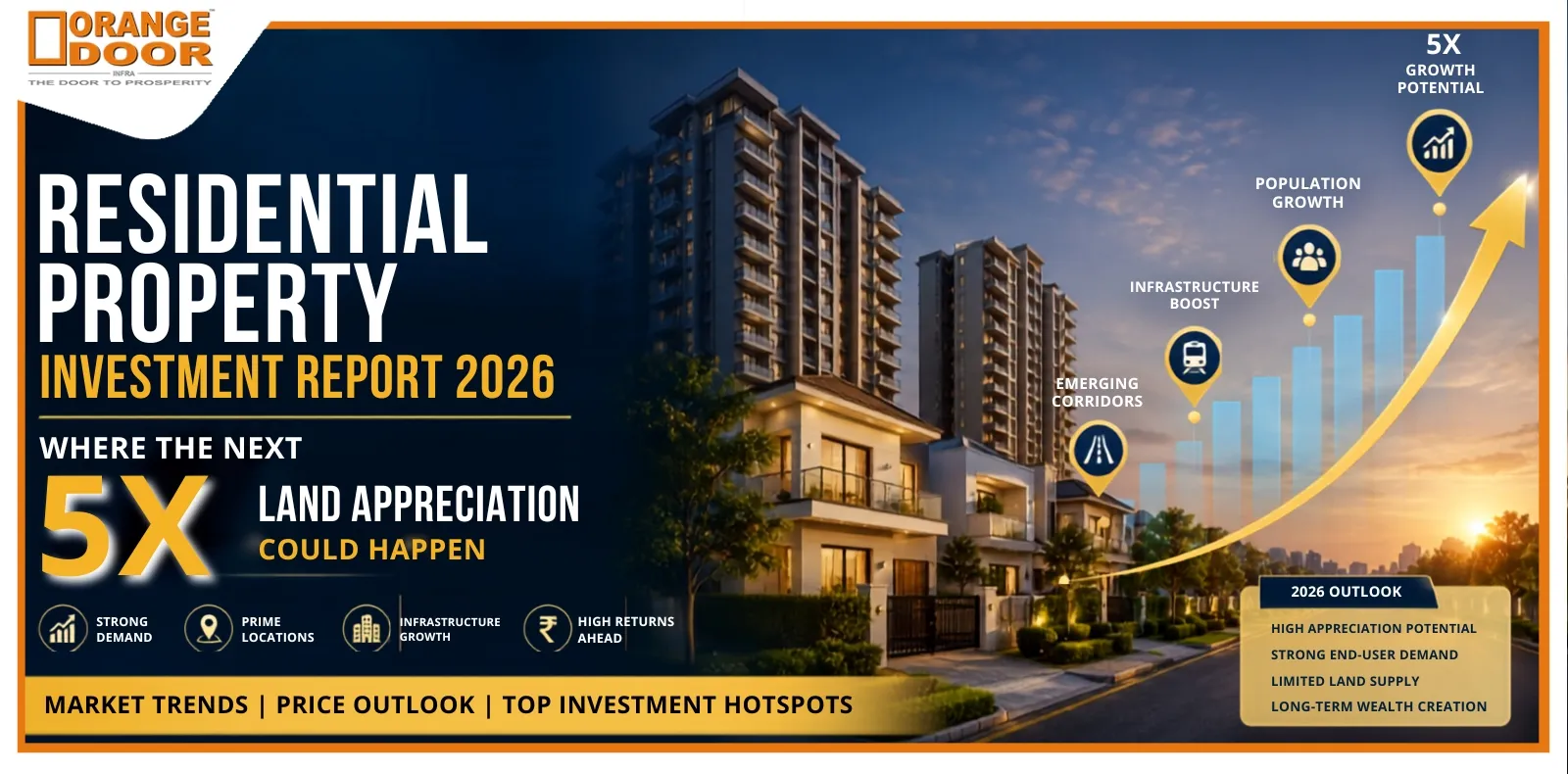
Quick answer - Land appreciation is currently outpacing built residential property in specific infrastructure-linked corridors — most notably along the Yamuna Expressway near Jewar Airport, and in Hyderabad's Kokapet, Pune's Hinjewadi Phase 3, and Gurgaon's Dwarka Expressway. Yamuna Expressway plot rates alone moved from roughly ₹1,650/sq ft in 2020 to about ₹10,500/sq ft in 2025 — over 5x growth in five years — according to market data compiled by property advisory PropCompany.in. This report walks through the sourced data, the mechanism driving it, and — just as important — the risks that this kind of forecast carries.
A completed apartment begins depreciating structurally the moment it's occupied — wear, aging finishes, and functional obsolescence chip away at the building even as the land beneath it rises in value. Land carries no such depreciation curve. Its value is set almost entirely by scarcity, location, and proximity to infrastructure, which is why it tends to move first — and furthest — whenever a growth corridor opens.
Nationally, residential property appreciation is running at a moderate, unspectacular pace, while land in specific infrastructure-linked pockets has compounded far faster over three-to-five-year windows. That gap is the central thesis of this report — but it is a gap that exists in specific micro-markets, not as a national rule, and it compresses once infrastructure is actually delivered and priced in.
What's driving it in 2026:
Before comparing locations, get this variable right — it explains most of the difference in outcomes across every corridor in this report.
Land within roughly 1 km of a new metro station or expressway interchange has, in multiple tracked markets, commanded a 15–30% premium over comparable land just a few kilometers further out. That premium is not a one-time event; it is typically the early stage of a repricing that continues for years after the infrastructure becomes operational. Land bought before construction begins captures more of that curve; land bought after opening day captures whatever appreciation is left.
The practical filter: is the infrastructure only announced, under active construction, or already operational? Announced-but-unfunded infrastructure carries real cancellation and delay risk (see Risk Factors below) — this is the trade-off for the larger theoretical upside of buying earliest.
Five-year figures below refer to land/plot values specifically. Built residential property (apartments, villas) in the same micro-markets typically appreciates more slowly, partly offset by rental income that raw land does not generate.
This corridor is currently one of the most cited land-appreciation stories in the Delhi-NCR market. Plot rates along the Yamuna Expressway rose from roughly ₹1,650 per sq ft in 2020 to about ₹10,500 per sq ft in 2025 — a run some regional real estate coverage has described as one of the strongest five-year plot appreciation stories in NCR. The Uttar Pradesh government and YEIDA revised official circle rates upward by 10–15% in 2026, bringing residential plot circle rates in the Jewar Airport belt to roughly ₹17,000–21,000 per sq metre, and to ₹20,000–24,000 per sq metre closer to the Film City corridor and Sectors 28–32 — an official signal that valuations are catching up to market activity, not leading it. Separately, the Greater Noida Industrial Development Authority (GNIDA) raised its own allotment rates by 3.58% in May 2026, citing the Cost Inflation Index, pushing developed-locality plot rates to roughly ₹51,363 per sq metre.
The core catalyst is Noida International Airport (Jewar), alongside the Film City project in Sector 21 and planned metro connectivity to Noida. Some market commentary projects a further 80–120% appreciation for Yamuna Expressway property once the airport becomes fully operational and the Noida–Jewar metro link is complete — this figure should be treated as an optimistic scenario tied to two large infrastructure projects still under execution, not a guaranteed outcome. Regional coverage has also flagged real execution risk here: the FNG Expressway and related connectivity projects have faced land-acquisition delays, and increased builder launches expected by 2027 could add supply that moderates price growth in Greater Noida specifically, even as the Yamuna Expressway sub-corridor continues to outperform.
Kokapet has shown among the steepest land-appreciation forecasts of any tracked corridor, with the Outer Ring Road belt close behind, both supported by continued IT-sector expansion and improving road connectivity.
Hinjewadi Phase 3 has been driven primarily by continued IT-park expansion, with Kharadi close behind; Pune Metro completion is acting as a secondary catalyst on top of existing tech-corridor demand.
Bangalore's job-creation base has kept these corridors among the more consistent performers nationally, with residential appreciation broadly outperforming the national average.
Plot values here rose sharply in the twelve months to H1 2026 — among the steepest of any tracked micro-market in that window — driven by constrained land supply against steady investor demand, with under-construction inventory in the same corridor posting even sharper gains.
No appreciation forecast in this report is guaranteed, and treating it as one would be a disservice to readers making real financial decisions. The specific risks worth weighing before acting on any corridor above:
Gross rental yields on residential property in India currently average in the low-single-digit percentages nationally, which can help offset loan interest for financed purchases — a buffer that raw land, generating no income, does not provide.
Headline appreciation percentages routinely overstate what an investor actually nets. A simplified illustration for a hypothetical ₹50 lakh plot purchase, using figures published in this report's sources — treat this as a methodology template, not a specific prediction:
| Line item | Amount / Assumption |
| Purchase price | ₹50,00,000 |
| Stamp duty + registration (5–8%) | ₹2,50,000 – ₹4,00,000 |
| Total entry cost | ₹52,50,000 – ₹54,00,000 |
| Holding period | 5 years |
| Gross appreciation (illustrative, corridor-dependent) | 60–150% over 5 years |
| Exit value (illustrative) | ₹80,00,000 – ₹1,25,00,000 |
| Less: LTCG tax (12.5%, no indexation, on gains, per current rules) | Applies to gain above entry cost |
| Less: any loan interest paid over holding period (if financed) | Deducted from net return |
| Net effective return | Materially lower than the headline appreciation figure |
The point of this table isn't the specific numbers — they will vary by corridor and entry timing — it's the method: always net out acquisition costs, financing costs, and capital gains tax before comparing a "5x" headline figure to any other asset class.
The residential property story in 2026 isn't about picking the "best" city — it's about identifying the right distance from confirmed infrastructure, at the right stage of execution, while pricing in the real risks of delay, oversupply, and illiquidity that headline appreciation figures tend to omit. The Yamuna Expressway/Greater Noida corridor, alongside Kokapet, Hinjewadi Phase 3, and Dwarka Expressway, currently show the data points supporting outsized land appreciation — but "could happen" is doing real work in that phrase, and every figure above should be independently verified before capital moves.
Q1. What is driving land appreciation in Greater Noida and the Yamuna Expressway in 2026?
Ans. Primarily the Noida International Airport at Jewar, the Film City project in Sector 21, and planned metro connectivity — official YEIDA circle rates rose 10–15% in 2026 in response to this activity.
Q2. Is land a better investment than residential property in 2026?
Ans. It depends on the investor's goals. Land has shown stronger pure appreciation in several infrastructure-linked corridors, while built residential property offers rental income alongside typically slower, steadier appreciation and greater liquidity.
Q3. How much could the Yamuna Expressway property appreciate after Jewar Airport opens?
Ans. Some market commentary projects 80–120% appreciation post-operationalization, but this is an optimistic scenario tied to the airport and metro link being completed on schedule, not a guaranteed figure — treat it as an upside case, not a base case.
Q4. How does capital gains tax affect land investment returns in India?
Ans. Property sold within two years is taxed at the seller's income slab rate; after two years, long-term capital gains tax applies at 12.5% without indexation under current rules — a material factor in holding-period planning.
Q5. What's the biggest risk in buying land for appreciation rather than building property? Ans. liquidity and infrastructure-delivery risk. Land is harder to exit quickly than built or listed property, and its entire appreciation thesis often depends on infrastructure projects that can be delayed, altered, or cancelled.




Comments