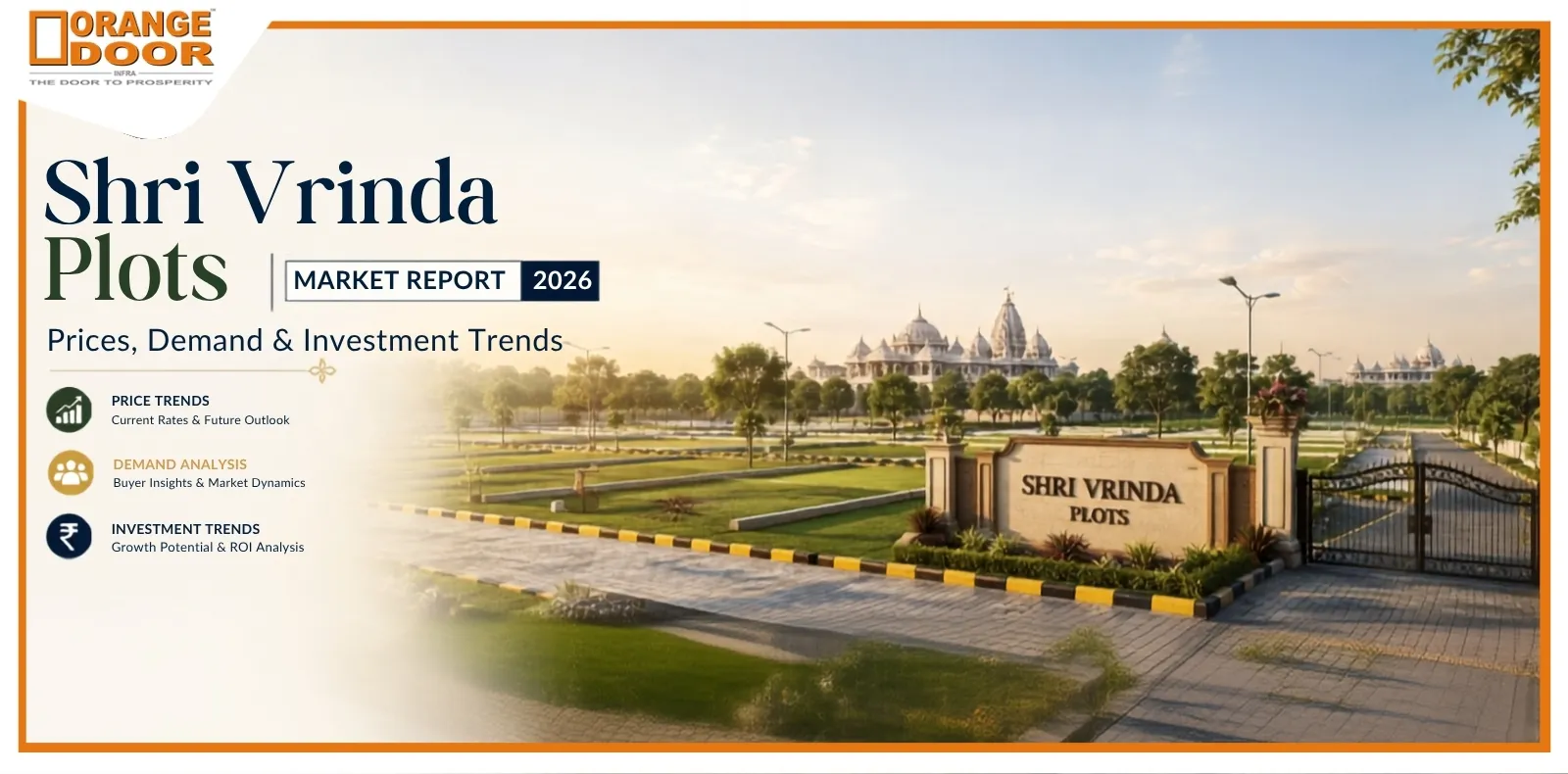
Vrindavan's plotted-land segment has moved from a niche, pilgrimage-belt category into a genuine investment conversation over the past few years, and Shri Vrinda Plots is one of the projects at the center of that shift. Whether you're a homebuyer, investor, NRI, broker, or institutional allocator sizing up this project, the real question isn't just where the price stands today — it's what's driving that movement, how sustainable it is, and what risks are worth weighing before a booking form gets signed. This report works through all three.
Consider this a working analysis, not marketing copy dressed up as editorial. It covers pricing trajectory, land economics, the demand forces specific to the Vrindavan-Mathura micro-market, and a due-diligence checklist built the way a seasoned real estate practitioner would actually run it — before recommending anyone put capital in.
| Metric | Detail |
| Launch price | ₹35,000 / sq. yard |
| Current price (2026) | ₹38,000 / sq. yard |
| Price appreciation since launch | +8.57% |
| Total land parcel | 60 bigha |
| Approx. land parcel (converted)* | ~37.5 acres / ~1.81 lakh sq. yards |
| Asset category | Residential plotted development |
| Region | Vrindavan–Mathura belt, Uttar Pradesh |
Shri Vrinda Plots is currently priced at ₹38,000 per sq. yard, up from a launch price of ₹35,000 per sq. yard — an 8.6% appreciation to date — across a 60-bigha township. In isolation, that number tells you demand has outpaced the initial pricing — developers rarely revise prices upward without booking velocity to justify it. What it does not tell you, and what any serious investor should ask before extrapolating this into a forecast, is:
None of this means the appreciation is unjustified — it likely reflects real demand in the region (see below). It means a disciplined investor treats the price trend as one input, not a complete investment thesis on its own.
At roughly 37.5 acres, Shri Vrinda Plots sits in the mid-to-large range for a single-phase plotted township in the Vrindavan-Mathura corridor — large enough to support internal infrastructure (roads, green belts, community spaces) without being a mega-township where amenity delivery typically lags sales by several years.
A few things this scale implies for investors:
Residential plots in Vrindavan have seen sustained developer activity over the past several years, and the demand thesis for the region rests on a few structural factors rather than short-term sentiment:
These are regional tailwinds, not guarantees specific to Shri Vrinda Plots. They explain why plot pricing across this belt has generally trended upward — they don't substitute for project-specific due diligence.
Homebuyers seeking a second home or retirement plot in a spiritually significant, well-connected location may find the current pricing point reasonable relative to comparable plotted inventory in the belt — but should prioritize possession timeline and construction-readiness of infrastructure over price alone.
Investors targeting 3–7 year capital appreciation should treat the 8.6% post-launch gain as an early signal, not a projected annual return, and should model returns against verified comparable transactions in the immediate micro-location rather than township-wide averages.
NRIs evaluating this as a long-distance investment should insist on video-verified site visits, a lawyer-reviewed title report, and confirmation that the developer accepts NRE/NRO-compliant payment channels before remitting funds.
Developers and institutional allocators assessing bulk inventory or JV opportunities should focus on absorption rate per phase and the developer's track record of on-time possession across prior projects in the region, not just current pricing.
Short-term flippers should be cautious: plotted land in Tier-2 religious-tourism belts typically rewards patient capital (5+ year horizons) more reliably than 1–2 year flips, given that liquidity for resale plots in these markets is thinner than in metro residential markets.
Before any commitment, verify the following directly with the developer or through independent legal counsel:
Q1. What is the current price of Shri Vrinda Plots?
Ans. As of 2026, Shri Vrinda Plots is priced at ₹38,000 per sq. yard, up from its original launch price of ₹35,000 per sq. yard.
Q2. How much has the price of Shri Vrinda Plots increased since launch?
Ans. The price has increased by ₹3,000 per sq. yard, or approximately 8.57%, since launch.
Q3. How big is the Shri Vrinda Plots township?
Ans. The project spans a total land parcel of 60 bigha, which converts to roughly 37.5 acres using standard Uttar Pradesh land-measurement norms — buyers should confirm the exact saleable area from the approved layout plan.
Q4. Is investing in residential plots in Vrindavan a good long-term option?
Ans. Plotted land in the Vrindavan-Mathura belt has generally benefited from sustained religious tourism, improving connectivity, and constrained land supply near core temple zones — factors that support a medium-to-long-term investment case. As with any real estate decision, returns depend on project-specific factors like approval status, location within the township, and execution timeline, so independent due diligence is essential.
Q5. Who is Shri Vrinda Plots suitable for?
Ans. The project profile fits homebuyers seeking a second home or retirement plot, medium-to-long-term investors, and NRIs looking for a spiritually significant location with development-authority approval — subject to individual verification of legal and financial terms.



Comments